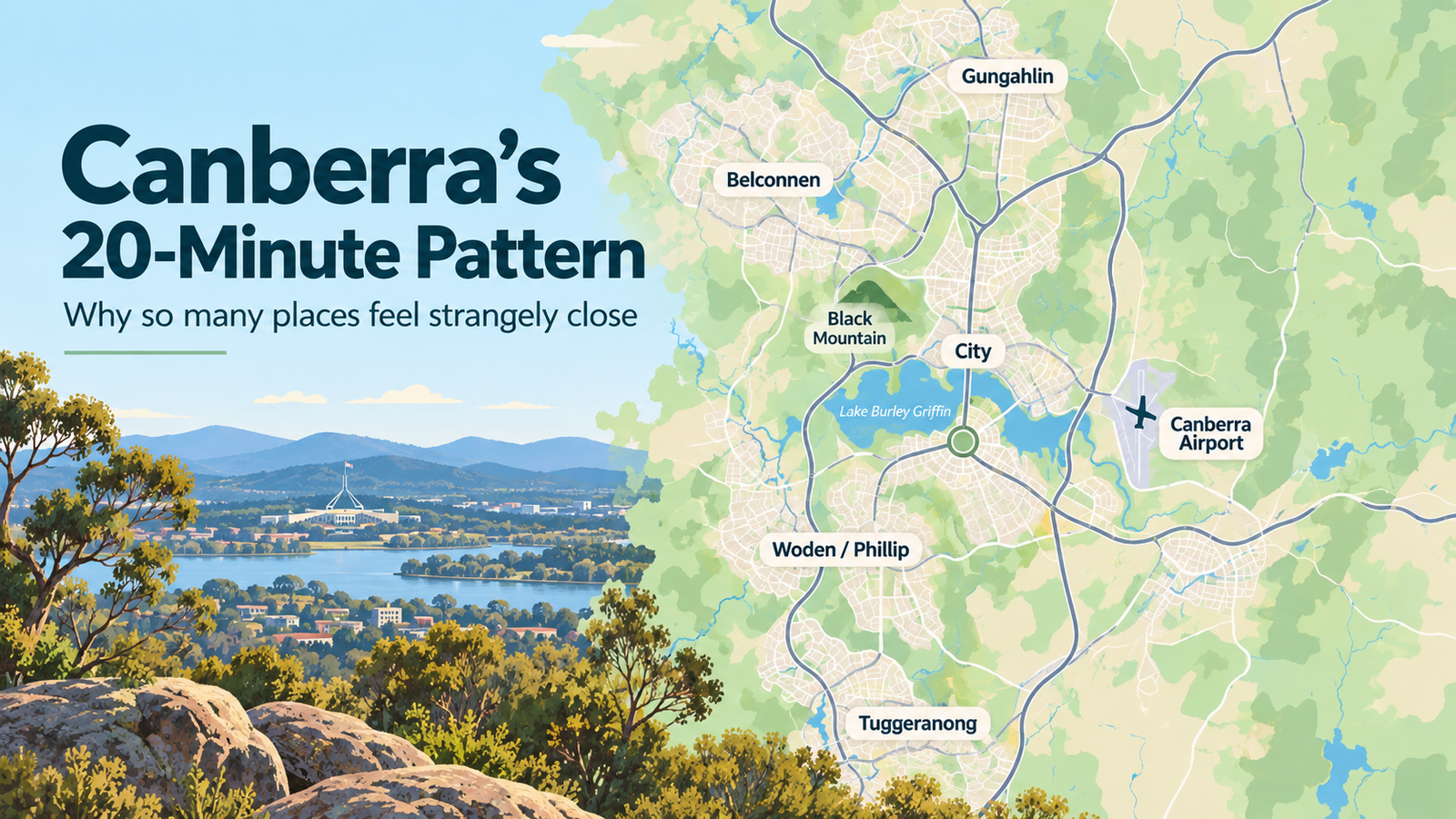
One of the funniest things I have noticed after living in Canberra for several years is how often the answer to this question seems to be the same:
“How long does it take to get there?”
“About 20 minutes.”
At first, I thought it was just coincidence.
Then I started thinking about the places I actually drive to.
I live in Phillip, close to Woden Town Centre.
Woden to the City?
Usually around 15 to 20 minutes outside peak hour.
Woden to Tuggeranong?
Around 20 minutes.
Woden to Belconnen?
Again, roughly 20 minutes.
Belconnen to Gungahlin?
Around 20 minutes.
Travel farther across the city and the number usually starts moving closer to 30.
Woden to Gungahlin?
Around 30 minutes.
Tuggeranong to the City?
Also around 30 minutes.
Of course, peak hour changes everything.
Roadworks can change it too.
But outside the busy periods, Canberra has a strange rhythm to it.
A surprising number of major places seem to fall into roughly the same 15-to-25-minute driving range.
And once you notice it, it becomes difficult to stop noticing it.
Canberra is not really a one-centre city
I think the pattern makes more sense once you look at how Canberra is organised.
Canberra does not feel like one enormous CBD with everything else simply spreading outward from it.
Instead, it has a network of major town centres.
From the City, the map almost starts to form a pattern.
To the west is Belconnen.
To the north is Gungahlin.
To the south is Woden, with Tuggeranong farther south.
Belconnen, Gungahlin, Woden and Tuggeranong are all major hubs for shopping, services, employment, transport and the residential areas around them.
That is much closer to how Canberra feels to me in everyday life.
I do not really think of Canberra as one centre surrounded by distant suburbs.
I think of it more as several important centres connected together.
And when you start looking at the driving times between them, something funny happens.
Woden to Tuggeranong: around 20 minutes.
Woden to Belconnen: around 20 minutes.
Belconnen to Gungahlin: around 20 minutes.
Woden or Belconnen to the City is a little shorter, usually around 15 to 20 minutes in my experience.
Go across a larger section of Canberra, such as Woden to Gungahlin or Tuggeranong to the City, and the journey becomes closer to 30 minutes.
The distances are different.
The directions are different.
Yet the travel times keep falling into strangely familiar ranges.
Then I started wondering about the east
Then I looked at the map again.
Belconnen gives Canberra a major centre to the west.
Gungahlin sits to the north.
Woden and Tuggeranong stretch south.
So I started wondering:
What is on the east side?
There is no equivalent major town centre immediately east of the City.
But there is one very important destination there.
Canberra Airport.
And this is where the pattern became even more amusing to me.
From Woden, I usually think of the airport as roughly a 16-to-20-minute drive outside peak hour. When the roads are clear, it often feels closer to 16 or 17 minutes.
From Belconnen, it is roughly around 20 minutes.
From Gungahlin, again, it sits in roughly the same general 20-minute range depending on the route and traffic.
So even when I add a completely different kind of destination on the eastern side of Canberra, that familiar number comes back again.
About 20 minutes.
Of course, the physical distances are not equal.
That is exactly what makes it interesting.
Different distances.
Different directions.
Different roads.
But surprisingly similar travel times.
My own Canberra driving pattern
These are not official travel times.
They are approximate times based mainly on my own off-peak driving experience around Canberra.
| Route | My typical off-peak experience |
|---|---|
| Woden → City | ~15–20 min |
| Belconnen → City | ~15 min |
| Gungahlin → City | ~20 min |
| Woden → Tuggeranong | ~20 min |
| Woden → Belconnen | ~20 min |
| Belconnen → Gungahlin | ~20 min |
| Woden → Gungahlin | ~30 min |
| Tuggeranong → City | ~30 min |
| Woden → Canberra Airport | ~16–20 min |
| Belconnen → Canberra Airport | ~20 min |
| Gungahlin → Canberra Airport | ~20 min |
The exact number changes depending on the exact starting point, traffic, roadworks and time of day.
What interests me is not whether one trip takes exactly 18 minutes or 21 minutes.
It is the consistency of the overall pattern.
A lot of major destinations seem to sit somewhere around 15 to 20-something minutes away from the next important point.
Cross a larger part of the city and it becomes roughly 30.
Canberra starts to feel almost modular.
My Korean grocery shopping makes this even more obvious
One of the best everyday examples for me is grocery shopping.
There are two Korean grocery stores I go to regularly.
One is in the City.
The other is in Mitchell.
On the map, Mitchell is not just a little farther north than the City.
It is noticeably farther up.
You can look at the map and immediately see that these are not comparable distances from Phillip.
And yet in everyday life, the decision often feels almost identical.
If I think:
“Today I’ll go to the Korean grocery store in the City.”
It feels like about 20 minutes.
On another day I can decide:
“I’ll go to Mitchell instead.”
And somehow that also feels like about 20 minutes.
I genuinely find that funny.
The distances are clearly different, but the road network keeps flattening those differences into surprisingly similar travel times.
That is such a small everyday thing, but I think it says a lot about how Canberra works.
The city is not actually shrinking the physical distance.
It is making very different destinations feel unusually similar in travel time.
I think Canberra’s planned road network deserves a lot of the credit
Canberra was designed as a planned city, and I think you can actually feel that when you drive around it.
Major arterial roads connect different districts without forcing every journey through one single central bottleneck.
That does not mean Canberra never has traffic.
It absolutely does.
Peak hour is the obvious exception.
Roadworks can make an otherwise simple journey much less simple.
But outside those periods, Canberra often feels unusually predictable.
That predictability is part of what makes the city feel smaller than it actually is.
On a map, Canberra is spread out.
Behind the wheel, it often feels compact.
And this is where living without a car becomes interesting
This is also why I think the question “Can you live in Canberra without a car?” is more complicated than it first appears.
Canberra feels extremely well connected when you are driving.
But the same geography does not always feel equally connected without a car.
A journey that takes 20 minutes by car might involve:
- walking to a bus stop
- waiting for the service
- travelling to an interchange
- changing buses
- waiting again
- walking from the final stop
Suddenly, a city that felt compact becomes much larger.
That is Canberra’s strange transport paradox.
The road network makes the city feel small.
Without access to that road network as a driver, the distances can feel very different.
Public transport works well when your life matches the network
This does not mean Canberra has poor public transport.
Some major connections are actually very good.
Transport Canberra’s Rapid services link town centres and other key destinations and generally run at least every 15 minutes between 7am and 7pm on weekdays. :chatgpt-content-reference{index=”0″}
Transport Canberra currently lists travel from the City to Woden or Belconnen at about 20 minutes by Rapid service. It also lists the light rail journey between the City and Gungahlin at about 24 minutes. :chatgpt-content-reference{index=”1″}
Gungahlin and Belconnen are also connected by Rapid R8 in about 20 minutes. :chatgpt-content-reference{index=”2″}
So public transport is not automatically slow.
On the right route, it can work very well.
The real question is whether your personal life matches the network.
If your home, workplace and regular destinations sit along one direct Rapid or light rail corridor, living without a car can be surprisingly practical.
If they do not, the difference between driving and public transport becomes much more noticeable.
Light rail may change the south side significantly
At the moment, light rail mainly benefits the north side of Canberra.
The current operating line connects Gungahlin with the City.
But the network is moving south.
Light Rail Stage 2A, from the City to Commonwealth Park, is currently under construction. Construction is expected to be completed in 2027, followed by testing and commissioning, with passenger services planned to commence in 2028. :chatgpt-content-reference{index=”3″}
Stage 2B is planned to continue from Commonwealth Park to Woden.
The ACT Government has confirmed the Stage 2B alignment, and the proposed extension would add nine new stops on the route to Woden. Planning and environmental approvals are still progressing. :chatgpt-content-reference{index=”4″}
For someone living in Phillip, this is a significant future change.
Right now, Woden to the City is already an easy drive for me.
In the future, there should also be a direct light rail connection between those major centres.
That could change the car-free equation considerably for the south side.
Where living without a car works well
In my view, car-free living in Canberra works best when most of your life stays within one well-connected part of the city.
For example:
- you live near a major town centre
- you live close to light rail or a direct Rapid route
- your workplace is on the same corridor
- groceries and essential services are within walking distance
- you work from home at least part of the week
- you do not regularly travel across several districts
- you are comfortable combining public transport with walking or cycling
Under those conditions, a car may be more of a convenience than a necessity.
Where it becomes harder
The problem appears when your life is spread across multiple centres.
Work in Woden.
Appointments in Belconnen.
Friends in Gungahlin.
Shopping in the City.
A weekend trip to Tuggeranong.
With a car, Canberra handles that lifestyle extremely well.
Twenty minutes.
Another twenty.
Maybe thirty if you are crossing a larger part of the city.
Without a car, the same day can require much more planning.
And I think that is the real difference.
Canberra is not necessarily a difficult city to live in without a car.
It is simply an unusually convenient city to live in with one.
Walking and cycling help more than people may expect
Canberra does have another major advantage for people who do not drive.
Its walking and cycling network is extensive.
The ACT Government manages approximately 3,800 kilometres of community paths across Canberra, including traditional footpaths and off-road shared paths used for walking and cycling. :chatgpt-content-reference{index=”5″}
For shorter trips, cycling can completely change how practical a suburb feels.
A place that looks inconvenient by bus may become quite manageable when cycling is added to the equation.
That means the most practical car-free lifestyle in Canberra may not rely on one mode of transport.
It may be:
walking + cycling + buses + light rail.
Although Canberra winter mornings occasionally make that plan much less appealing.
So, can you live in Canberra without a car?
Yes.
Absolutely.
But I think the answer depends less on Canberra itself and more on how your personal life fits into Canberra’s network.
If your home, work, shopping and regular activities are concentrated around one well-connected town centre or transport corridor, you may be perfectly comfortable without a car.
If your life regularly crosses Belconnen, Gungahlin, Woden, Tuggeranong, the City and other parts of Canberra, owning a car becomes much more valuable.
And strangely, that is partly because Canberra is so easy to drive around.
The road network turns a geographically spread-out city into a collection of surprisingly short and oddly consistent journeys.
West.
North.
South.
East to the airport.
The distances are different.
The roads are different.
Even places like the City and Mitchell are clearly not equally far away.
Yet somehow, from everyday life behind the wheel, the answer keeps coming back to roughly the same range:
“About 20 minutes.”
That is one of the small things about Canberra that I never expected to find so interesting.
But now that I have noticed it, I cannot stop seeing it.
If you live in Canberra, have you noticed the same pattern?
And if you live here without a car, does the city feel completely different to you?
Official sources
Transport Canberra – Central regional guide
Transport Canberra – Gungahlin regional guide
ACT Government – Light Rail Stage 2A
ACT Government – Light Rail Stage 2B
ACT Government – Community paths
This article includes my personal observations from living in Canberra. Driving times are approximate and are based mainly on my typical off-peak experience. Actual travel times vary depending on traffic, roadworks, weather, time of day and the exact starting and destination points.
Leave a Reply