Author: Darren

  • NDIS Plan Reassessment Changes from 27 August 2026: What Participants and Support Coordinators Need to Know

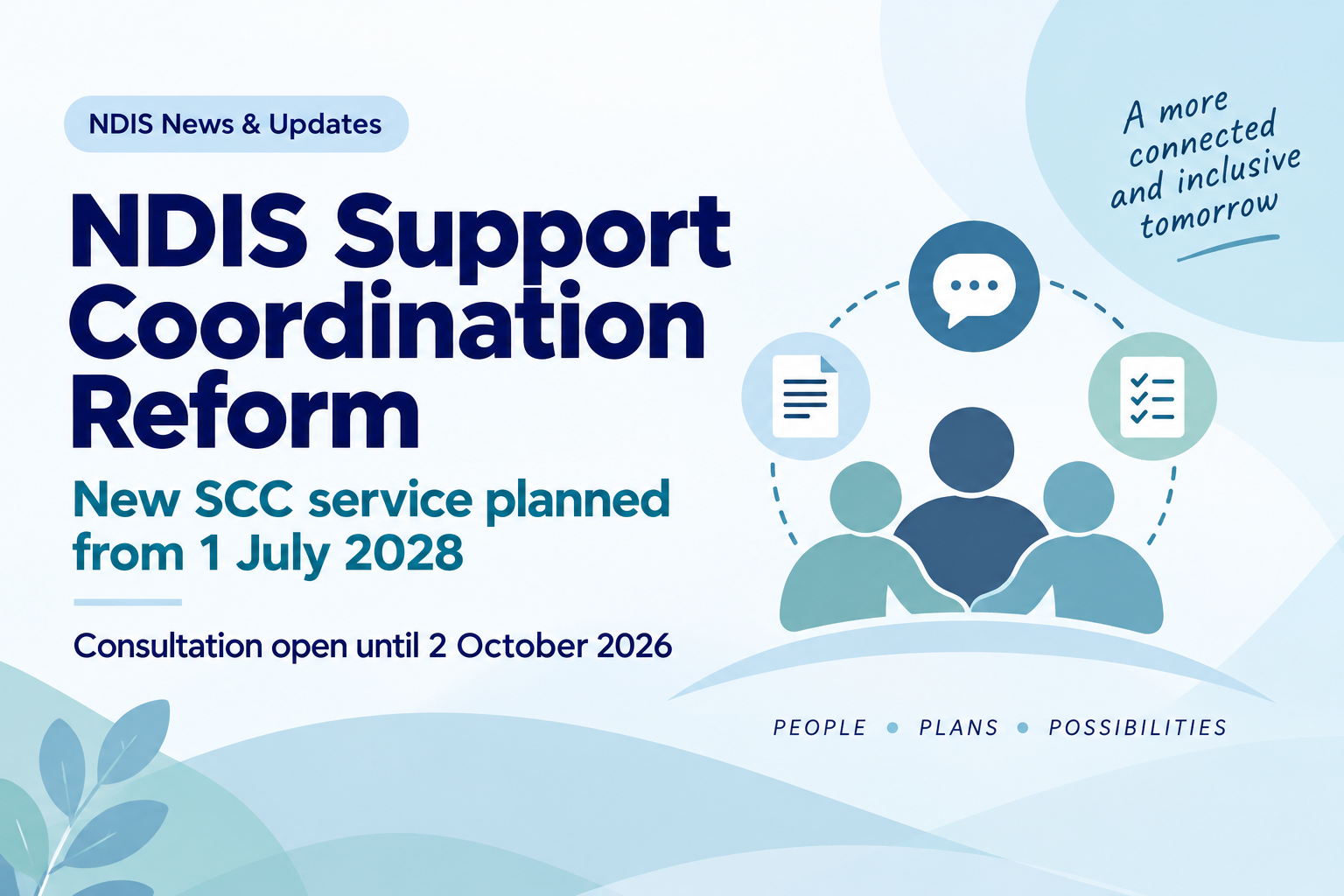
    From 27 August 2026, the NDIS changed the way participants can request a plan reassessment.

    The change may look fairly procedural at first, but there is one important difference that participants, nominees and Support Coordinators should be aware of:

    A Support Coordinator can no longer submit a plan reassessment request on behalf of a participant.

    There are also clearer requirements around who can make the request, which form must be used, what information needs to be provided and what supporting evidence should be included.

    Here is a practical summary of what has changed and what it may mean if you are considering asking for changes to an NDIS plan.

    What changed from 27 August 2026?

    Only the following people can now request a plan reassessment:

    • the participant
    • the participant’s plan nominee
    • a child representative

    A Support Coordinator, provider or other support person cannot submit the plan reassessment request on the participant’s behalf.

    The request must also be submitted using the correct NDIS plan reassessment request form.

    The form needs to explain:

    • what has changed
    • why the participant needs a plan reassessment
    • what evidence supports the request

    Supporting evidence may include reports or assessments from treating healthcare professionals, therapists or support workers.

    This matters because a plan reassessment is generally intended for situations where there has been a significant and ongoing change in the participant’s circumstances or support needs.

    What happens after the request is submitted?

    Once the NDIA has the information and evidence it needs, it has up to 90 days to make a decision about the request.

    The NDIA may decide to:

    • reassess the plan
    • not reassess the plan
    • vary the existing plan instead

    Participants can continue using their current plan while the NDIA considers whether a reassessment is needed.

    If the NDIA agrees that a full reassessment is required, a new plan may then be developed based on the participant’s current circumstances and support needs.

    What participants should prepare

    A reassessment request should not simply say that more funding or different supports are needed.

    It should clearly explain what has changed since the current plan was approved.

    Depending on the situation, useful evidence may include:

    • medical reports
    • allied health reports
    • functional assessments
    • therapy reports
    • support worker observations
    • evidence of changes to living arrangements
    • evidence of changes to informal supports
    • information about changes in work, education or daily functioning

    The stronger the connection between the change in circumstances, the participant’s disability-related needs and the requested supports, the easier it is for the NDIA to understand why a reassessment may be necessary.

    What does this mean for Support Coordinators?

    Support Coordinators still have an important role.

    They can help participants understand the process, gather evidence and prepare supporting information.

    They can also help identify whether the issue may be better addressed through a plan reassessment or a plan variation.

    What has changed is who can formally submit the reassessment request.

    The participant, plan nominee or child representative must now make that request.

    In practice, this means Support Coordinators may spend more time helping participants prepare a complete request rather than submitting the request themselves.

    Plan reassessment vs plan variation

    Not every change requires a full reassessment.

    A plan reassessment is generally more appropriate when there has been a significant and ongoing change in the participant’s support needs or circumstances and the existing plan no longer adequately meets those needs.

    A plan variation may be more appropriate when only part of the current plan needs to change.

    The NDIS says plan variations may be used for smaller changes and can also be considered where changes are urgent, minor or short-term.

    Examples of things that may sometimes be dealt with through a variation include changes to parts of the plan, corrections or certain smaller adjustments that do not require the creation of an entirely new plan.

    The NDIA currently advises that it will generally make a decision on a plan variation request within 21 days once it has the information and evidence it needs.

    If you are not sure which type of request is appropriate, the NDIS recommends speaking with your my NDIS contact.

    A practical checklist before requesting a reassessment

    Before submitting a plan reassessment request, it may help to check that you have:

    • identified the specific change in circumstances
    • explained why the current plan no longer meets the participant’s needs
    • gathered relevant supporting evidence
    • obtained reports or assessments where appropriate
    • used the correct NDIS reassessment form
    • checked that the request is being made by the participant, plan nominee or child representative

    It is also worth considering whether the change is significant and ongoing, or whether a plan variation may be enough.

    Why this change matters

    For many participants, the practical impact will be relatively simple: the participant or their authorised representative now needs to formally make the reassessment request.

    But for people who rely heavily on Support Coordinators to manage NDIS processes, the distinction is important.

    Support Coordinators can still do much of the preparation work, but the final reassessment request must come from an authorised person.

    That makes it even more important for participants and their support teams to prepare the evidence properly before the request is submitted.

    The NDIS is continuing to update its guidance as broader legislative changes are introduced, so it is worth checking the official NDIS website before submitting a request.

    ‘If you have a general question about this update, or there is another NDIS topic you would like me to cover, feel free to leave a comment below.

    Official sources

    NDIS – Changes to plan reassessments
    NDIS – How to ask for a change to your plan
    NDIS – What is a plan reassessment
    NDIS – What is a plan variation

    This article is for general information only and does not constitute legal, financial or individual NDIS advice. For advice about your own plan or circumstances, contact the NDIS or speak with your my NDIS contact.

  • Living in Canberra: Why I Moved Here and What Changed in Four Years

    Living in Canberra: Why I Moved Here and What Changed in Four Years

    Canberra was never the place I expected to call home.

    Before moving here, I was living in Sydney. Canberra first came onto my radar because of visa considerations, but that was only what made me look at the city in the first place.

    What actually made me want to live here was Canberra itself.

    I visited for what was basically a scouting trip, just to see what the place was really like. Somewhere along the way, I found myself thinking, I could actually live here.

    More than four years later, I still think moving to Canberra was one of the best decisions I made in Australia.

    My first impression of Canberra

    Canberra has an unusual balance that I still appreciate today.

    It has almost everything I actually need from a city: shopping centres, supermarkets, restaurants, hospitals, public transport and the everyday services that make life convenient.

    Some people might argue that Canberra barely counts as a city.

    I disagree.

    If a place has the infrastructure I need to live comfortably, while still letting me enjoy open space, nature and beautiful scenery every day, that sounds like a pretty good city to me.

    And that combination is probably what attracted me most.

    One of my favourite things about Australia has always been its natural environment and scenery. In Sydney, I loved escaping into nature whenever I had the chance.

    In Canberra, it often feels like nature is simply part of the commute.

    One of the things I still love about Canberra is how easily the city opens up into water, hills and open sky.

    There are mornings when the drive to work feels less like a commute and more like a short reset before the day begins.

    Wide roads, open skies, hills in the distance and stretches of greenery are just part of ordinary life here.

    I still haven’t really got tired of it.

    Canberra was much quieter when I arrived

    When I first moved here, Canberra felt noticeably quieter than it does today.

    And by quieter, I mean really quiet.

    There was a reason I heard people jokingly describe Canberra as a ghost town.

    One Christmas Day, I went out hoping I might find somewhere open for a cup of coffee.

    I walked around the area near a shopping centre for quite a while.

    No people.

    No passing cars.

    Almost nothing.

    I ended up filming it because the whole scene felt so strange.

    Canberra on Christmas Day a few years ago. I walked around for quite a while without seeing another person or even a passing car.

    If I uploaded that clip today without context, someone might reasonably ask whether it was generated by AI.

    It genuinely looked that empty.

    A short clip from the same walk. The streets stayed almost completely empty.

    Even the bus stop felt abandoned that day. No waiting passengers, no traffic, just a very quiet Christmas afternoon in Canberra.

    Canberra feels different now

    Four years later, Canberra feels busier.

    I don’t necessarily need population statistics to notice it. I can feel it on the roads, in shopping centres and in places that once seemed almost empty.

    There are more cars, more people and more development.

    The city feels as though it is gradually filling in.

    That’s exciting in some ways.

    More people usually means more businesses, more restaurants, more services and more reasons for new things to open.

    At the same time, I occasionally miss how ridiculously easy it used to be to drive almost anywhere.

    Traffic in Canberra is still very manageable compared with Sydney, at least from my experience, but there are definitely more cars on the road than there used to be.

    Apparently, you can’t keep all the advantages of a growing city without eventually sharing the road with a few more people.

    What I still like most about living here

    For me, Canberra’s biggest advantage is not one particular attraction.

    It’s the overall quality of everyday life.

    I can get to the things I need without feeling as though I am constantly fighting the city.

    I can go shopping, get to work, find good food, access services and still be surrounded by scenery that reminds me why I liked Australia in the first place.

    Canberra can certainly feel quiet.

    For someone who wants nightlife, endless crowds and a city that never slows down, that may be a disadvantage.

    For me, it became part of the appeal.

    There is enough here to live comfortably, without everything feeling overwhelming.

    Is Canberra a good place to live?

    I don’t think Canberra is perfect for everyone.

    If you love the constant energy of Sydney or Melbourne, it may feel too quiet.

    If you prefer a slower pace, easier driving, access to nature and a city that still has most of the conveniences you need, Canberra is worth considering.

    My original reason for looking at Canberra may have been practical.

    The reason I stayed was much simpler.

    I liked living here.

    And after more than four years, even with the city getting busier and the roads slowly filling up, I still find myself appreciating the scenery on an ordinary drive to work.

    That’s probably the best summary I can give of Canberra.

    It has enough city to make life convenient, and enough nature to make ordinary life feel a little less ordinary.