I expected stronger record keeping to make operations clearer.
Instead, I started hearing something unexpected from otherwise suitable cleaning and gardening contractors:
“NDIS work may not be worth taking on.”
That caught my attention.
Not because record keeping is new. It isn’t.
NDIS providers have already been required to keep complete and accurate records of the supports they deliver.
The more interesting question is what happens when those evidence requirements meet ordinary service businesses that do not naturally operate like traditional disability support providers.
That is where I think cleaning and gardening reveal an important practical tension.
NDIS record keeping is not new
NDIS providers already need to keep complete and accurate records of supports delivered to participants.
Depending on the type of support, these records may include invoices, support logs, rosters, case notes and service agreements.
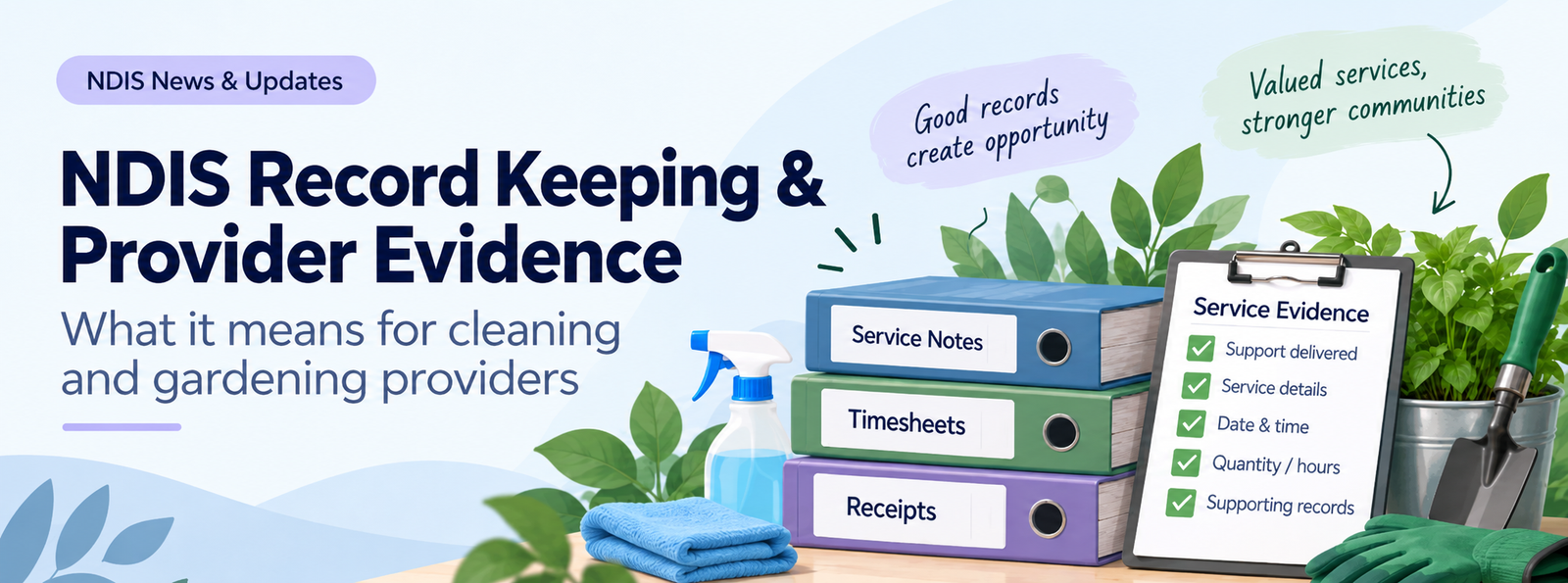
At a minimum, records should show key information such as the participant’s name and NDIS number, when the support was delivered, the amount or quantity or hours delivered, and the support type.
Providers are also responsible for making sure their claims are complete, truthful and accurate.
So it would be misleading to say that record keeping suddenly became an NDIS requirement in August 2026.
The obligation was already there.
What has changed is the broader compliance environment around it.
What changed in 2026?
New NDIS laws began taking effect from 27 August 2026.
Some changes started immediately, while others are being introduced progressively.
This means providers are continuing to work under existing record-keeping obligations while also preparing for a wider reform program affecting plans, claims, funding and provider operations.
One of the upcoming changes relates to how long records about supports and payments need to be retained.
The NDIS currently lists future retention periods of:
- 3 years for participants
- 5 years for nominees
- 7 years for providers
The NDIS currently describes these record-retention changes as “coming soon”, with further information still expected about how the requirements will operate in practice.
So the seven-year period should not be described as though every implementation detail is already fully in place.
But the direction is clear.
Long-term evidence and record management are becoming increasingly important.
Why evidence still matters
There are good reasons for this.
NDIS claims can be reviewed against provider records, and providers may need to show that a support was actually delivered and that the quantity or hours claimed are accurate.
If sufficient evidence cannot be provided, payments may be questioned or recovered.
That is why providers cannot simply ignore documentation requirements.
The difficulty begins when those requirements meet businesses that normally operate under a very different commercial model.
Why cleaning and gardening are different
Many cleaning and gardening businesses do not price every job using a simple:
hours worked × hourly rate
model.
A quote may instead reflect things such as:
- property size and condition
- accumulated workload
- equipment required
- access
- waste removal
- difficulty
- expected finish standard
- total scope of work
- labour efficiency
An experienced contractor may finish a job faster than another contractor without delivering lower quality.
In an ordinary commercial market, that efficiency can be part of the contractor’s value.
NDIS claiming, however, still needs to connect the claim to the support that was actually delivered and to evidence of the quantity or hours provided, while staying within applicable pricing and claiming arrangements.
That is where the two models can start to rub against each other.
The issue is not simply that there is “more paperwork”.
It is that NDIS evidence and claiming requirements may not always fit neatly with the way ordinary cleaning and gardening businesses normally price and deliver their work.
What I am seeing in practice
In my day-to-day operations work, we use a digital system internally to make record keeping more consistent.
That includes things such as service start and finish times, service notes and supporting information.
This is our internal operational approach. The NDIS does not require providers to use one particular app or software platform.
When NDIS-specific documentation expectations are explained to external cleaning and gardening contractors, I have seen mixed reactions.
Some businesses are comfortable adapting.
Others are not.
In several cases, otherwise suitable contractors became hesitant or chose not to proceed after the documentation and administrative expectations were explained.
Some contractors have told me that if the documentation process and, where relevant, hourly claiming arrangements do not fit their normal business model, NDIS work becomes less attractive to them.
That does not mean those businesses oppose good record keeping.
It means the NDIS model may not fit the way they normally operate.
Why this matters for participants
This matters because cleaning and gardening sit partly inside the NDIS market and partly outside it.
The same businesses can often choose between NDIS-funded work and ordinary private customers.
If NDIS work requires more administration while also fitting less naturally with a contractor’s usual commercial model, some businesses may simply choose other work.
If that happens often enough, participants may face fewer suitable providers, longer waiting times or less choice.
That is where what looks like a provider compliance issue can become a participant access issue.
And that is the part I think deserves more attention.
The real issue is not whether records matter
They do.
Accurate records help protect participants, providers and NDIS funding.
The harder question is whether the compliance and claiming model can remain strong while still being workable for ordinary service markets such as cleaning and gardening.
For these services, there needs to be room for both:
- reliable evidence and accurate claiming
- a provider market that remains commercially practical enough to participate
If that balance is lost, stronger compliance may still achieve its intended purpose, but participants could find it harder to access the services they need.
Final thoughts
NDIS record keeping is not a new requirement.
What is changing is the wider compliance environment around it.
As the 2026 reforms continue to roll out, providers will need stronger and more reliable evidence systems.
At the same time, cleaning and gardening businesses will still be operating in a broader commercial market that does not always think in NDIS terms.
From what I have seen in practice, that tension is already real.
The challenge is not choosing between compliance and access.
It is finding a model where both can work.
Have you seen cleaning, gardening or other small businesses become more hesitant about NDIS-funded work because of documentation or claiming requirements?
I’d be interested to hear how others are managing that balance.
Official sources
NDIS – What are the record keeping requirements
NDIS – Securing the NDIS for future generations
NDIS – Manual payment review
This article includes my personal observations from working in NDIS operations. The views expressed are my own and do not represent my employer, the NDIA or an official NDIS position. NDIS requirements and implementation details may change as reforms continue to roll out.
Leave a Reply