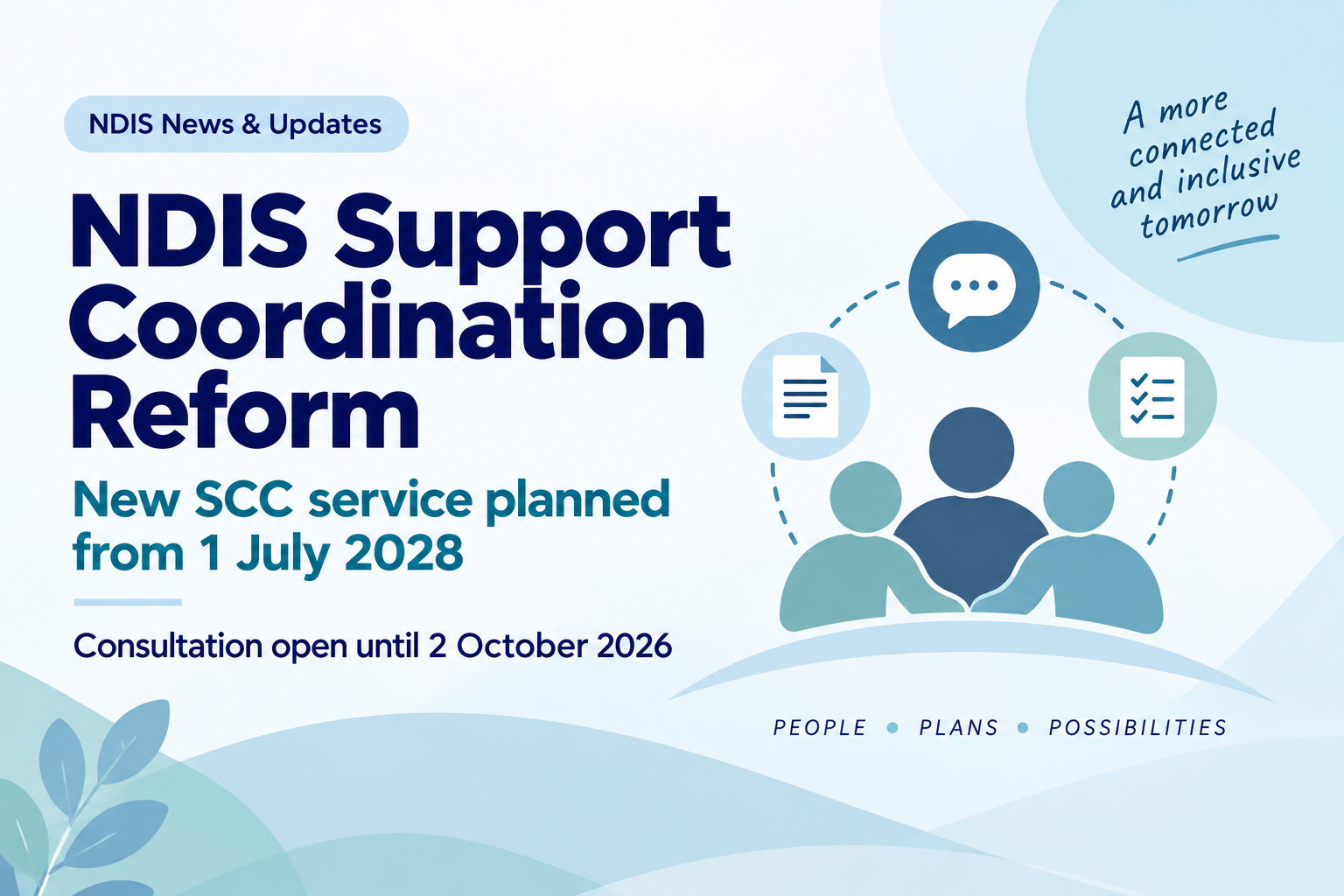
On 7 September 2026, the Australian Government opened consultation on the future of NDIS Support Coordination.
The consultation focuses on the proposed design of a new commissioned NDIS Support Coordination and Connection service, often referred to as the SCC service.
The new service is planned to begin from 1 July 2028 and is intended to replace the way NDIS participants currently receive Support Coordination services.
That sounds like a significant change, but there is one important point to keep in mind:
The final design has not yet been decided.
The current consultation is part of the process that will help shape how the new service may work.
What has been announced?
The Australian Government has announced that a new commissioned NDIS Support Coordination and Connection service is planned from 1 July 2028.
According to the NDIS, the reform is intended to improve:
- service quality
- consistency
- safeguarding
- clarity around provider roles
- responsiveness to participant needs
The Department of Health, Disability and Ageing and the NDIA have developed early ideas for how the future service could operate.
Feedback gathered through the current consultation will help inform advice to government before the final design is decided.
Is Support Coordination ending now?
No.
The announcement does not mean that Support Coordination is stopping now.
The new commissioned SCC service is planned to begin from 1 July 2028, and the current consultation is focused on shaping the future design of that service.
For now, the important point is that the future Support Coordination model is being redesigned, but many of the details have not yet been finalised.
What could change?
The government has said the new SCC service will replace the way participants currently receive Support Coordination services.
However, many important details are still being developed.
The consultation is seeking feedback on issues including:
- what the future service should do
- how quality and safeguarding should work
- how services should be delivered
- how participants can be supported to understand their plans
- how participants can access and coordinate their supports
Because the final design has not yet been decided, it would be premature to assume exactly what the future role of Support Coordinators will look like.
Why is the government reviewing Support Coordination?
The NDIS says Support Coordinators play an important role in helping participants understand, access and coordinate supports.
At the same time, the government has identified areas where it believes the system could improve, including consistency, quality, safeguarding and clearer provider roles.
The proposed SCC model is intended to explore a different way of delivering these functions.
Whether the final model improves the experience for participants will depend heavily on how the details are designed and implemented.
Who can provide feedback?
The consultation is open to a broad range of people and organisations.
The government is encouraging feedback from:
- people with disability
- NDIS participants
- families, carers and kin
- advocates
- disability support workers
- disability service providers
- organisations that may be interested in delivering the future SCC service
- the broader disability community
Feedback can be provided through the Australian Government Consultation Hub.
If you would like to contribute, you can make a submission through the Australian Government Consultation Hub before 11:59 pm AEST on 2 October 2026.
My perspective
I find this announcement particularly interesting because Support Coordination has been an area of increasing change within the broader NDIS reform process.
In a previous article about recent plan reassessment changes, I discussed how some NDIS processes appear to be placing more direct responsibility on participants and authorised representatives.
That was my personal observation, not an official NDIS position.
The SCC announcement should not be treated as confirmation that the Support Coordinator role is simply being reduced or removed.
What it does confirm is that the way Support Coordination is delivered is expected to change.
For participants, families, workers and providers, the next two years will be important as the details of the new model are developed.
Why this consultation matters
Support Coordination can have a major impact on how effectively a participant understands and uses their NDIS plan.
For some participants, a good Support Coordinator can help make an extremely complex system much easier to navigate.
That is why changes to this part of the NDIS deserve careful attention.
Questions worth considering include:
- Will participants still have enough choice about who supports them?
- How will service quality be monitored?
- How will continuity of support be protected?
- How will conflicts of interest be managed?
- What will happen to existing Support Coordination providers?
- How will the new system work for participants with complex support needs?
- Will regional and remote participants have equal access to services?
These are the kinds of practical questions that may become more important as the new model develops.
What happens next?
The consultation will remain open until 2 October 2026.
After feedback is gathered, it will help inform advice to the Australian Government.
The final design of the SCC service will then be a decision for government.
The new commissioned service is currently planned to begin from 1 July 2028.
Between now and then, further details are likely to be released as the reform progresses.
I will continue following the changes and update this blog as more information becomes available.
If you work with the NDIS, use Support Coordination, or support someone who does, I would be interested to hear what you think about the proposed changes.
What parts of the current Support Coordination system should be protected, and what could be improved?
Official sources
NDIS – NDIS reform: Have your say on NDIS support coordination and connection service
Australian Government Department of Health, Disability and Ageing – Support Coordination and Connection Consultation
This article is for general information only and reflects information available at the time of publication. It does not constitute legal, financial or individual NDIS advice.
Leave a Reply